-
Past modal verbs of deduction: Grammar chart
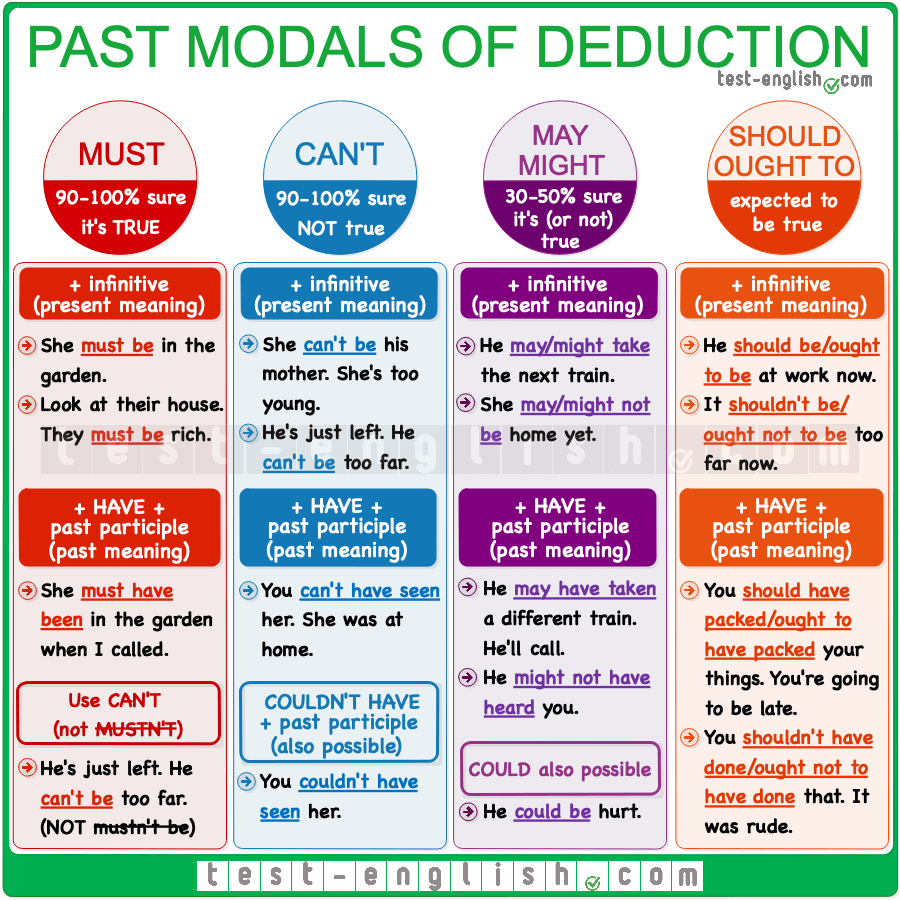
Download full-size image from Pinterest
Modal verbs of deduction and speculation
We can use some modal verbs + an infinitive to talk about how certain we are that something is or is not true. We can also use some modal verbs + have + past participle to talk about how certain we are that something was or was not true in the past.
Must have done
We use must have + past participle to say that we are quite sure that something was true or happened in the past.
- I can’t find my wallet! I must have dropped it in the taxi.
- You must have had a real scare when you saw the crocodile.
Can’t have done
We use can’t/couldn’t have + past participle to say that we are quite sure that something did NOT happen or was NOT true in the past.
- You can’t/couldn’t have seen John last night. He was in hospital.
- She can’t/couldn’t have passed the test. She didn’t even open the books.
❗ Note that for negative deduction, we use can’t (NOT mustn’t)
- He mustn’t be that famous.

- He can’t be that famous.

Could/might/may have done
We can use could have + past participle to say that something was possible in the past or someone had the possibility to do something but didn’t do it.
- You could have called me to say you weren’t coming. I waited for hours.
We can also use could/might/may have + past participle to say that it’s possible that something was true or happened in the past.
- It’s been three days. They might/may have finished painting the house by now.
- If they left at 9, they might/may have already arrived.
❗ Note that we use might not or may not (NOT could not) to talk about a negative possibility.
- She might/may not have heard us. Knock again.
Should/ought to have done
We use should have/ought to have + past participle to talk about a situation expected to happen in the past. This form is normally used for criticism.
- You should/ought to have already packed your things. We’re going to be late.
- He should/ought to have studied more. Nobody fails if they study.

-

Subscribe to enjoy PDF downloads!
Subscribe to our PRO platform to enjoy all these extra features:
- PDF downloads of all lessons and tests
- Improved design with no ads
- Track your progress
- Level badges for every skill
- Leaderboards to compete with other learners
Exercises
Explanation
Downloads


